Cartridge vs DE Filters: What a Dirty Filter Does to Pressure, Flow and Your Pump
Your filter is the part of the pool you never see until it starts costing you money.
October 19, 2026 · 4 min read
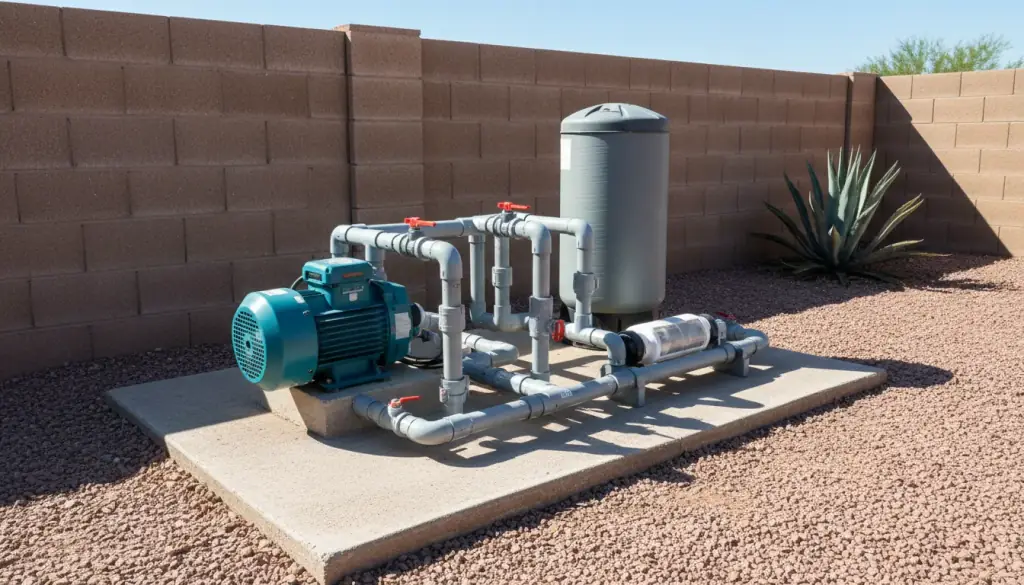
Most West Valley pool owners know they have a pump and a filter somewhere on the equipment pad, and not much more than that. That is fine until the water goes cloudy for no obvious reason or the pump starts sounding strained. In both cases the filter is a good first suspect. Here is what the two common types do and what happens when either one gets dirty.
How the two filters differ
A cartridge filter holds one or more pleated fabric elements inside a tank. Water passes through the pleats, and dirt stays trapped on the surface. When the cartridge is loaded, you remove it, clean it and put it back. There is no backwashing, which is simpler and wastes less water.
A DE filter uses a set of grids coated with diatomaceous earth, a fine powder. The powder builds a thin layer on the grids that catches very small particles. When the filter loads up, it is backwashed to flush out the old powder and fresh powder is added. Many people feel DE gives a polished finish to the water, but it takes more hands-on care.
Neither type is the right one for everybody. The best filter for your pool is usually the one already installed and maintained properly. If you are replacing equipment anyway, it is worth talking through the tradeoffs, since the upkeep each one asks of you is very different.
What a dirty filter actually does
A filter works by making water squeeze through a material that holds back dirt. As that material fills up, it gets harder for water to get through. That single fact causes most of the trouble.
First, pressure climbs. The gauge on top of the filter shows how hard the pump is pushing against resistance. A clean filter reads lower and a loaded one reads higher. The useful habit is to note the reading right after a cleaning, since every pool has its own normal. When the needle has climbed well above your baseline, the filter is asking for attention.
Second, flow drops. Less water moves through the system, which means less water reaches the skimmers, the returns and any heater or salt system downstream. Many of those devices need steady flow to work at all. Poor circulation also means chlorine does not spread evenly, so corners of the pool can start to go bad while the middle looks fine.
Third, the pump suffers. A pump pushing against a clogged filter runs under strain, uses more power and heats up. Over time that wears out seals and motors earlier than they should go. Replacing a pump or motor costs far more than cleaning a filter, which makes this one of the cheapest forms of pool insurance there is.
Signs your filter needs attention
- The pressure gauge reads well above where it sat after the last cleaning.
- Water stays hazy even though the chemistry tests fine.
- The return jets push out noticeably weaker flow than before.
- The pump sounds strained or feels hot to the touch.
- The pool turns green or cloudy faster than it used to.
- Debris sits on the surface longer because the skimmers are pulling less.
How often does it need cleaning
There is no single schedule that fits every pool. A pool under a mesquite tree in Avondale loads its filter faster than one with a clean yard in Sun City. Heavy swimming, dust storms, algae and monsoon runoff all add to the load. We watch the pressure and the water at each weekly visit so the cleaning happens when the pool needs it, not on a date picked from a chart.
A proper cleaning is more than a rinse. A thorough job gets deep into the cartridge pleats or the DE grids, so flow, filtration and the life of your equipment all benefit. Our filter cleaning service covers both cartridge and DE filters, and you can read about it at our Filter Cleaning page.
When cleaning is not enough
Filters wear out too. A cartridge with torn pleats or a DE grid with a split no longer catches what it should, and cleaning cannot fix that. A tank with a cracked fitting or a valve that leaks points to a repair. We diagnose and repair filters, pumps, motors and valves, and when a repair is no longer the cost-effective choice, we install replacement equipment. See our Pool Repairs page and our Equipment Installation page for both.
If your gauge is climbing or your water has been stubborn, send a message through our contact page or call or text (602) 316-3671. We serve Goodyear, Litchfield Park, Buckeye, Peoria, Surprise and the surrounding West Valley, and most quotes come back within 2 hours.
Phoenician Pool Spa Patio, (602) 316-3671
Call (602) 316-3671More articles
What Actually Happens on a Weekly Pool Visit in the West Valley
Four steps, one technician, and a photo of your pool in your inbox when we leave.
Why Arizona Heat Burns Off Chlorine and Drops Your Water Level
The sun does the damage quietly. Here is what to keep an eye on between visits.